
See the Full Project
What to Do When You Can't Sand Your Engineered Hardwood Floors
Most homeowners assume there are two options for worn hardwood floors: sand them down and refinish, or live with the wear. For engineered hardwood floors, especially older ones, neither of those is always the right answer. There's a third option — and it works better than most people expect.
The Problem With Engineered Floors and Sanding
Engineered hardwood is built differently than solid hardwood. It's a thin layer of real wood bonded on top of compressed plywood or layered wood substrate. That top layer — called the wear layer — is what gets sanded during a refinish.
Wear layers vary a lot. Some engineered floors have a wear layer thick enough to sand two or three times over their lifetime. Others are so thin that one full sand would cut straight through to the substrate underneath.
Before recommending anything, the floor needs to be assessed — not just from the surface, but from the inside. Pulling a floor vent cover and looking at the edge of a plank tells you a lot. So do larger dents and dings, which compress the wear layer and reveal how much wood is actually left.
If the wear layer is too thin, a full refinish isn't on the table. Neither is a standard buff and coat, at least not always.
Why a Standard Buff and Coat Doesn't Always Work
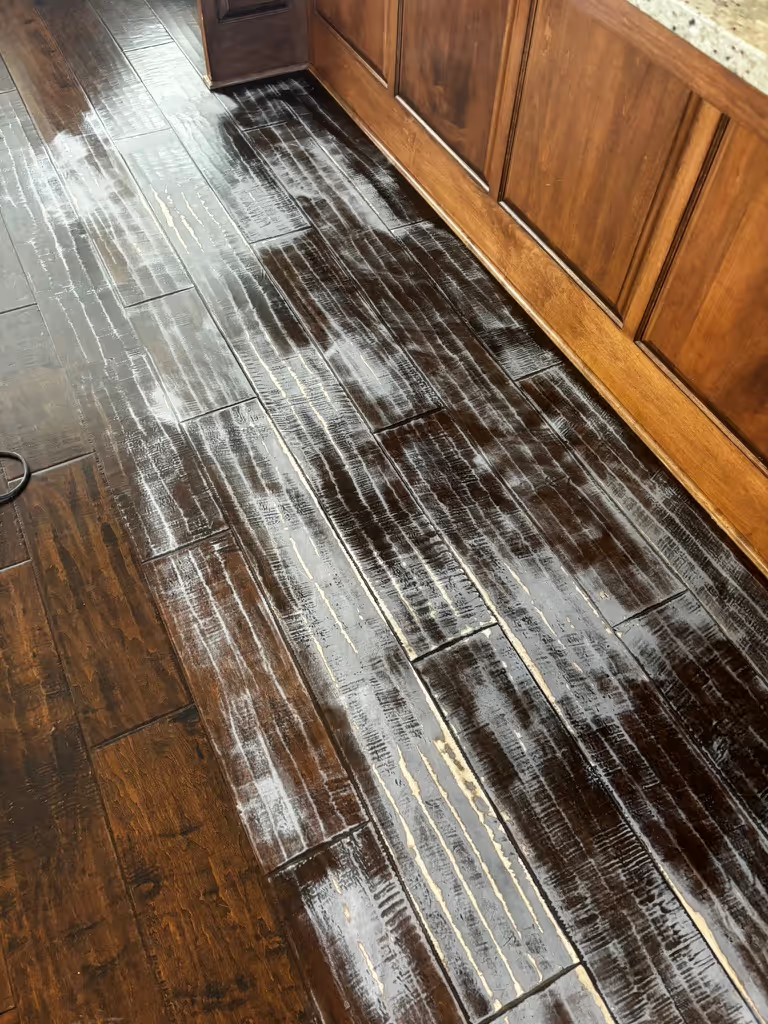
A buff and coat works by lightly scuffing the existing finish with a buffer, then applying a fresh coat on top. It's a good process — but it assumes the floor is flat enough to buff evenly.
Hand-scraped and distressed engineered floors have intentional highs and lows built into the surface. Running a buffer across that kind of floor would scalp the finish off the high points while barely touching the low ones. The result would be uneven color and sheen, and potentially more damage than you started with.
On that type of floor, even a buff and coat isn't the right call.
The Chemical Recoat Process
When a floor can't be fully sanded and can't be buffed, there's still a reliable path forward: a chemical recoat system.
The process uses a bonding agent — in this case, a product called Loba Contact — that gets rolled across the entire floor. It softens the existing finish just enough to allow a new coat to adhere, without any mechanical abrasion at all. No buffer, no sandpaper on the main floor surface.
This is especially useful on factory-finished floors. Many factory finishes use aluminum oxide as a hardener, which makes them extremely durable but also very difficult to etch mechanically. A chemical system gets around that problem entirely.
The result is a fresh layer of protection applied evenly across the whole floor, including the valleys and texture of a hand-scraped surface.
What About Worn and Discolored Areas?
Color loss from heavy traffic — chair legs, barstools, pet traffic near doorways — is a separate problem. In areas where the stain color has worn through completely, some targeted work is still possible.
Those specific spots can be sanded down more aggressively, because the goal there isn't to preserve the finish — it's to get back to raw wood so stain can be reapplied. The area gets sanded, water-popped to open the grain, and then stained to bring the color back in line with the rest of the floor.
It's not a perfect match in every case, but it gets those areas significantly closer. Once the full recoat goes over everything, the transition becomes much less visible.
The Finish: Two-Component Polyurethane
On a chemical recoat, the finish applied on top matters. A two-component polyurethane — sometimes called a catalyzed finish — adds a hardener to the mix before application. It's more expensive than a standard single-component finish, but it offers two meaningful advantages.
First, durability. It's the most durable site-applied finish available. On a floor that's already thin and has already been through 15 years of use, adding the most protective layer possible makes sense.
Second, cure time. A two-component finish reaches full cure in about three days, compared to five or more for a standard water-based product. For a busy household, that's a real difference.

When This Process Makes Sense
A chemical recoat is worth considering when the floor is engineered hardwood with an unknown or thin wear layer, when the surface is hand-scraped, distressed, or textured, or when the finish is worn and starting to show through in high-traffic areas. It's also a strong option when the homeowner wants to extend the life of the floor without the cost and disruption of a full tear-out and reinstall.
It won't change the color of the floor, and it won't remove deep scratches or gouges. But it adds a durable new layer of protection, brings some visual consistency back to the surface, and can add years to a floor that would otherwise be heading toward replacement.
The Bottom Line
Engineered hardwood floors — especially older, factory-finished, or textured ones — need a different approach than solid hardwood. Before assuming a floor needs to be replaced or that nothing can be done, it's worth having someone take a real look at the wear layer and the surface condition.
A chemical recoat won't work for every floor. But when it's the right call, it can reset a floor that still has good structure and save a homeowner from a much larger project.
Key Takeaways
- Engineered hardwood has a thin wear layer — always assess before recommending a sand
- Hand-scraped and distressed surfaces can't be buffed without scalping the texture
- A chemical bonding agent allows a new finish coat to adhere without sanding or buffing
- Factory finishes with aluminum oxide are particularly well-suited to this process
- Isolated color loss can be addressed with targeted sanding, water-popping, and stain
- A two-component finish adds maximum durability and cures in 3 days
- This process extends the life of a floor that still has good structure — and avoids a much larger project
Related Projects
